THE i3 APPROACH
Pressure changes what leaders see before it changes what they do
Many leadership decisions that later look flawed seemed entirely reasonable at the time. The information looked credible, the risks manageable, the course of action defensible. What shifted was perception, quietly and incrementally, while the decision was still unfolding. The i3 approach starts there.

Patterns anyone developing leaders in high-stakes organisations will recognise
Pressure rarely announces itself as a single poor decision. More often it shows up as a drift that is easy to miss while it is happening.
- Decisions slow down while leaders wait for certainty that rarely arrives.
- Difficult messages are softened or avoided.
- Teams disengage after setbacks or external scrutiny.
- Leaders absorb too much responsibility and begin to exhaust themselves.
- Priorities blur as competing demands intensify.
None of these responses feels unreasonable in the moment. Over time, they shape judgement, relationships and trust.
How leaders return to sound judgement under pressure
i3 Leadership works with a four-part sequence. It describes what happens when pressure rises, and what leaders can practise to steady themselves within it.
01
Pressure distorts perception
Attention narrows, assumptions harden and signals become harder to read. Because these shifts are rarely dramatic, they often go unnoticed.
02
Clarity expands and steadies perception
Leaders widen their field of view, reopen options they had closed too early, and regain orientation. Clarity is something leaders return to through practice, and they can learn to return to it sooner.
03
Judgement anchors decisions in standards and purpose
Decisions are tested against what matters, not simply what is expedient.
04
Courage turns judgement into action
Leaders act on sound judgement despite uncertainty, discomfort or potential cost.
Six capabilities for leading under sustained pressure
In practice, i3 develops six leadership capabilities. Together they shape how leaders think, relate, decide and act when conditions become difficult, and they form the core of the i3 Leadership Programme®.
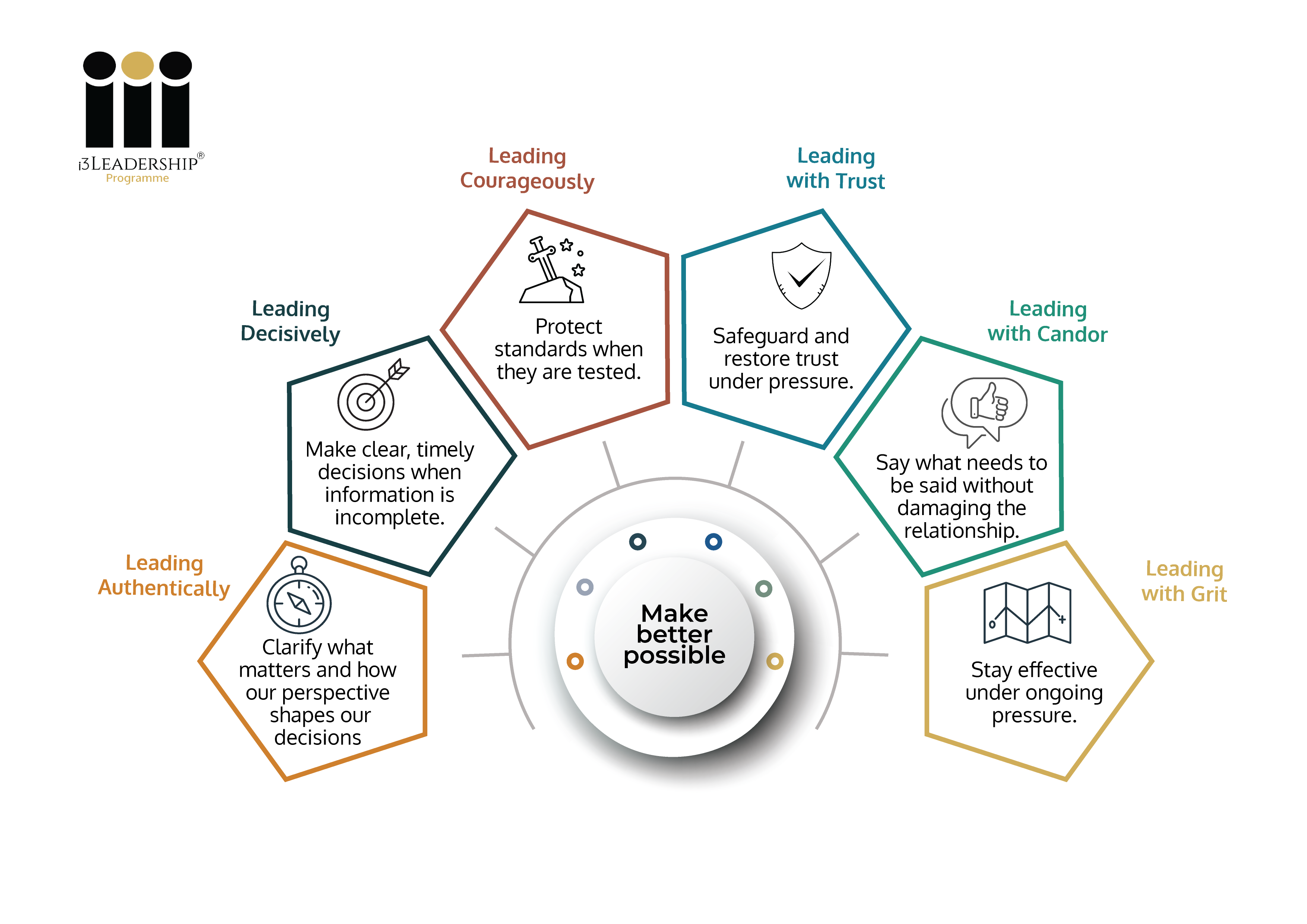
Grounded in behavioural science and regulated reality
The approach draws on leadership psychology, behavioural science and years of work with leaders in education, social care, housing, health and financial services. It is shaped by experience on both sides of scrutiny.
i3 Leadership was created by Julie Goddard, a leadership psychologist with an MSc in Business and Organisational Psychology, Fellow of the Institute of Leadership, certified leadership and team coach, and former Ofsted inspector.
Ways to work with i3
The same approach runs through every way organisations work with i3.
A four-month development programme for cohorts of leaders, combining six face-to-face days, one-to-one coaching and online peer support.
i3 Precision Pathways™
Short, focused courses on a single pressure point, such as deciding with incomplete information or rebuilding trust after scrutiny.
One-to-one coaching for leaders, either on its own or alongside the programme.
Keynotes and workshops
Talks and facilitated sessions on how pressure shapes perception and judgement, for conferences and leadership teams.
If you recognise these patterns in your organisation, let's talk about how i3 could work with your leaders.